





Rules of Thumb - Guidelines for building services
NB in 2024, BSRIA announced that BG 9/2011 Rules of Thumb 5th Edition would be replaced by:
- BG 85/2024 Mechanical Criteria
- BG 86/2024 Electrical Criteria
- BG 87/2024 Useful Information Guide
- Space and Weight Allowances BG84 2024
Rules of Thumb - Guidelines for building services (5th Edition) (BG 9/2011) was written by Glen Hawkins and published by BSRIA (Building Services Research and Information Association) in April 2011.
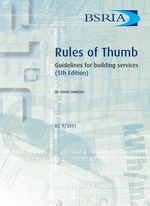
The book is a valuable source of engineering design, environmental performance and project cost data for building services projects.
[edit] Update for 2023
BG 9/2011 Rules of Thumb is one of BSRIA’s best-selling publications, providing useful data to help inform early stages of design. However, it is now 12 years old, so it might not meet the needs of the modern industry and some data may be out of date. BSRIA have just started a project to replace Rules of Thumb with a number of smaller publications with updated content. These are expected to be published later in 2023.
A major part of this project will involve consulting with the industry about the content of the new guides – what needs updating, what could be added or removed, and how it can be made more user-friendly. If you would like to take part in this consultation, please start by completing this short questionnaire. Your responses are highly confidential and we will then be in touch for further information. If you have any questions about this project, or would like updates on progress, please contact BSRIA’s publications manager David Bleicher.
BSRIA Questionnaire - Rules of Thumb replacement publications here.
[edit] About the previous edition
The rules of thumb provided are general principles derived from practice and experience. They have been created by referencing a range of contemporary sources and reflect current design practice. They can be useful in the early stages of design, such as briefing, feasibility studies and early concept design, helping assess:
- Space and weight requirements.
- Outline costs.
- Environmental performance targets.
- Heating, cooling and electrical loads.
They can also be used in later stages to ‘sense check’ detailed calculations and assess ‘what if’ scenarios.
The latest edition has been updated and expanded to provide more detailed information, including:
- More guidance about space and weight allowances.
- CO2 emissions benchmarks.
- Clearer guidance about costs, expanded to include energy consumption, maintenance, operation and life cycle cost information.
- A system features section, subdivided into mechanical and electrical systems.
- Guidance about compliance with Part L of the Building Regulations, renewable technologies and air permeability requirements.
The book is subdivided into 7 colour-coded sections:
- Space and weight.
- System features – mechanical building services, electrical building services and natural ventilation.
- Cooling, heating and electrical loads.
- Water consumption.
- Internal and external design criteria.
- Costs.
--BSRIA
[edit] Related articles on Designing Buildings
- Approved document L.
- Benchmarking.
- Blue book.
- BSRIA articles on Designing Buildings Wiki.
- BSRIA.
- Building regulations.
- Building services.
- Building services engineer.
- Confirming knowledge of building services.
- Cooling.
- Cost planning.
- Heating ventilation and air conditioning.
- Heating.
- Types of building services.
- Ventilation.
Featured articles
Check out some of the best features and news from Designing Buildings as well as key stories from around the web.
Code of Practice for Electrical Energy Storage Systems.

ECA calls on members to comment on draft 4th edition.

Bringing together expertise and creating cultural benefits.

CIOB celebrates positive Ofsted report.

The Building Safety Regulator announces a call for evidence.

Government approach could undermine delivery and regeneration.
World's first mass timber data centre.

The overlooked environmental aspect of data centre development.
Introduction to radon awareness

New technical information sheet published by CIOB.

Updated supplier guide can help electrical contractors engage with NHP.

CIAT confirm the winners of the 2026 architectural technology awards.

Government launches a one stop shop for flood preparedness.

Sir Edwin Lutyens: Britain's greatest architect? Book review.

CIOB publishes free template to help assess and manage risks.
Comments
[edit] To make a comment about this article, click 'Add a comment' above. Separate your comments from any existing comments by inserting a horizontal line.